Mathematical Thinking Development: From Concrete to Abstract
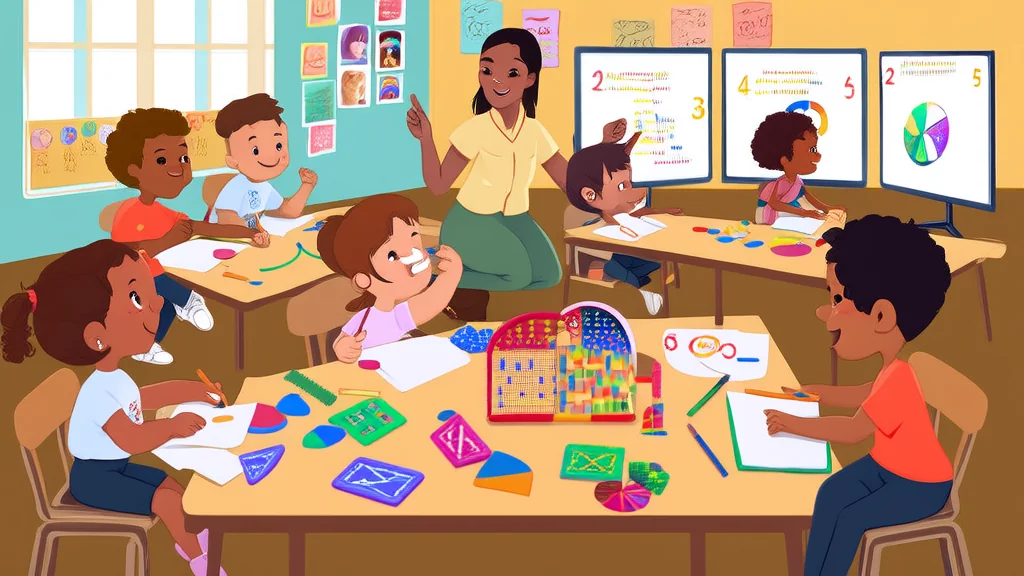
It was a crisp, autumn morning when I walked into Mrs. Thompson's 4th-grade classroom. The room was abuzz with the energy of young minds eager to learn. Today, they were tackling a new concept: fractions. I watched as Mrs. Thompson held up a large, colorful pizza and asked, "If we have one whole pizza and we cut it into four equal pieces, how many pieces do we have?" The students eagerly raised their hands, and one by one, they shared their answers. It was a simple, yet powerful moment that highlighted the journey from concrete to abstract thinking in mathematics.
This scenario is not just a snapshot of a typical day in a K12 classroom; it's a microcosm of the broader educational journey that students undertake as they develop their mathematical thinking. From the tangible, real-world objects like pizzas and blocks to the more abstract concepts of algebra and calculus, this journey is both fascinating and challenging. In this post, we'll explore the stages of mathematical thinking development, the importance of each stage, and how educators and parents can support this crucial process.
The Journey Begins: Concrete Experiences
Mathematics, at its core, is about understanding and manipulating patterns and relationships. For young learners, this understanding often starts with concrete experiences. In the early years, children use physical objects to make sense of numbers and operations. For example, using blocks to count, add, and subtract helps them grasp the basic concepts of arithmetic. These hands-on activities are not just fun; they are essential for building a strong foundation in mathematical thinking.
Research has shown that concrete experiences are crucial for developing number sense. A study by the National Council of Teachers of Mathematics (NCTM) found that students who engage in hands-on activities with manipulatives, such as blocks and counters, perform better in math than those who do not. This is because these activities help students visualize and internalize mathematical concepts, making them more meaningful and memorable.
Transitioning to Pictorial Representations
As students become more comfortable with concrete experiences, they begin to transition to pictorial representations. This stage involves using drawings, diagrams, and other visual aids to represent mathematical concepts. For example, instead of using actual blocks to add and subtract, students might draw pictures of blocks or use bar models to solve problems. This step is critical because it helps students bridge the gap between the concrete and the abstract.
Pictorial representations are particularly effective in helping students understand more complex concepts, such as fractions and ratios. For instance, drawing a pie chart to represent a fraction can make the concept more accessible and easier to understand. This visual approach also encourages students to think critically and creatively, as they must interpret and create their own representations of mathematical ideas.
Entering the Abstract Realm
Eventually, students reach the abstract stage, where they can work with numbers and symbols without the need for concrete or pictorial supports. This is the stage where students start to engage with algebraic expressions, equations, and more advanced mathematical concepts. While this stage can be challenging, it is also incredibly rewarding, as it allows students to apply their mathematical knowledge to a wide range of real-world problems.
Abstract thinking in mathematics requires a deep understanding of the underlying principles and the ability to reason logically. For example, solving an equation like \(2x + 3 = 7\) requires students to understand the properties of equality and the steps involved in isolating the variable. This level of thinking is not just about memorizing formulas; it's about developing a flexible and robust mathematical mindset.
The Role of Problem-Solving and Critical Thinking
Throughout the journey from concrete to abstract, problem-solving and critical thinking play a vital role. These skills are not just important for mathematics; they are essential for success in all areas of life. By engaging in problem-solving activities, students learn to approach challenges systematically, break down complex problems into manageable parts, and persevere in the face of difficulty.
One effective way to foster problem-solving and critical thinking is through open-ended tasks and real-world applications. For example, instead of simply solving a set of practice problems, students can be asked to design a budget for a school event or calculate the dimensions of a garden. These types of activities require students to apply their mathematical knowledge in a practical context, which enhances their understanding and engagement.
Supporting Mathematical Thinking Development
As educators and parents, there are several ways we can support the development of mathematical thinking in our students and children. Here are some practical strategies:
Provide Hands-On Learning Opportunities: Incorporate manipulatives and real-world objects into your lessons. For example, use blocks, coins, and other tangible items to teach counting, addition, and subtraction. This will help students build a strong foundation in number sense and make abstract concepts more concrete.
Encourage Visual Representations: Use drawings, diagrams, and other visual aids to help students understand mathematical concepts. For instance, when teaching fractions, use pie charts or fraction bars to illustrate the relationship between the parts and the whole. This will help students make the transition from concrete to abstract thinking more smoothly.
Foster a Growth Mindset: Encourage students to view challenges as opportunities for growth. Emphasize the importance of effort and persistence over innate ability. When students encounter difficulties, provide them with the tools and support they need to overcome obstacles and continue learning.
Integrate Real-World Applications: Connect mathematical concepts to real-world situations. For example, when teaching geometry, have students measure and calculate the area of different shapes in their environment. This will help students see the relevance of mathematics and deepen their understanding of the subject.
Conclusion
The journey from concrete to abstract thinking in mathematics is a complex and rewarding process. By providing students with hands-on learning experiences, encouraging visual representations, fostering a growth mindset, and integrating real-world applications, we can support their development and help them become confident and capable mathematical thinkers.
As I left Mrs. Thompson's classroom that day, I was reminded of the power of education to transform lives. Each student, armed with a piece of pizza and a newfound understanding of fractions, was taking a small but significant step on their mathematical journey. And as educators and parents, we have the privilege and responsibility to guide and support them every step of the way.